Project Background
This project came from a vision data simulation requirement for engineering equipment and infrastructure scenarios. The goal was to convert limited field samples, scenario descriptions and target-class requirements into reviewable, extensible data-generation materials. The scope covered three application directions: tunnel construction vehicle autonomy, railway-port gantry crane operation and bridge-structure defect inspection. The public case keeps only the technical method, deliverables and dataset statistics. It does not disclose the customer name, raw field images, complete business documents, quotation details or internal communication records.
The initial materials included a gantry-crane image package, engineering scenario requirements, customer-facing demonstration assets and data-collection guidance. Because the original gantry dataset contained images and a class list but no discovered bounding boxes or segmentation masks, this delivery is not presented as a complete detection-training dataset. It is positioned as an image-level simulation, synthetic sample generation, customer communication package and planning basis for later annotation.
Requirement Breakdown and Scenario Design
The work was organized into three layers. The first layer augmented gantry-yard images to simulate environmental variation that is difficult to cover in one field collection. The second layer generated samples for four target classes, including crane, container, cone and forklift. The third layer built customer-facing infrastructure scenarios across tunnel, port and bridge workflows so stakeholders could discuss target objects, environment variables, annotation scope and acceptance boundaries before a larger data program.
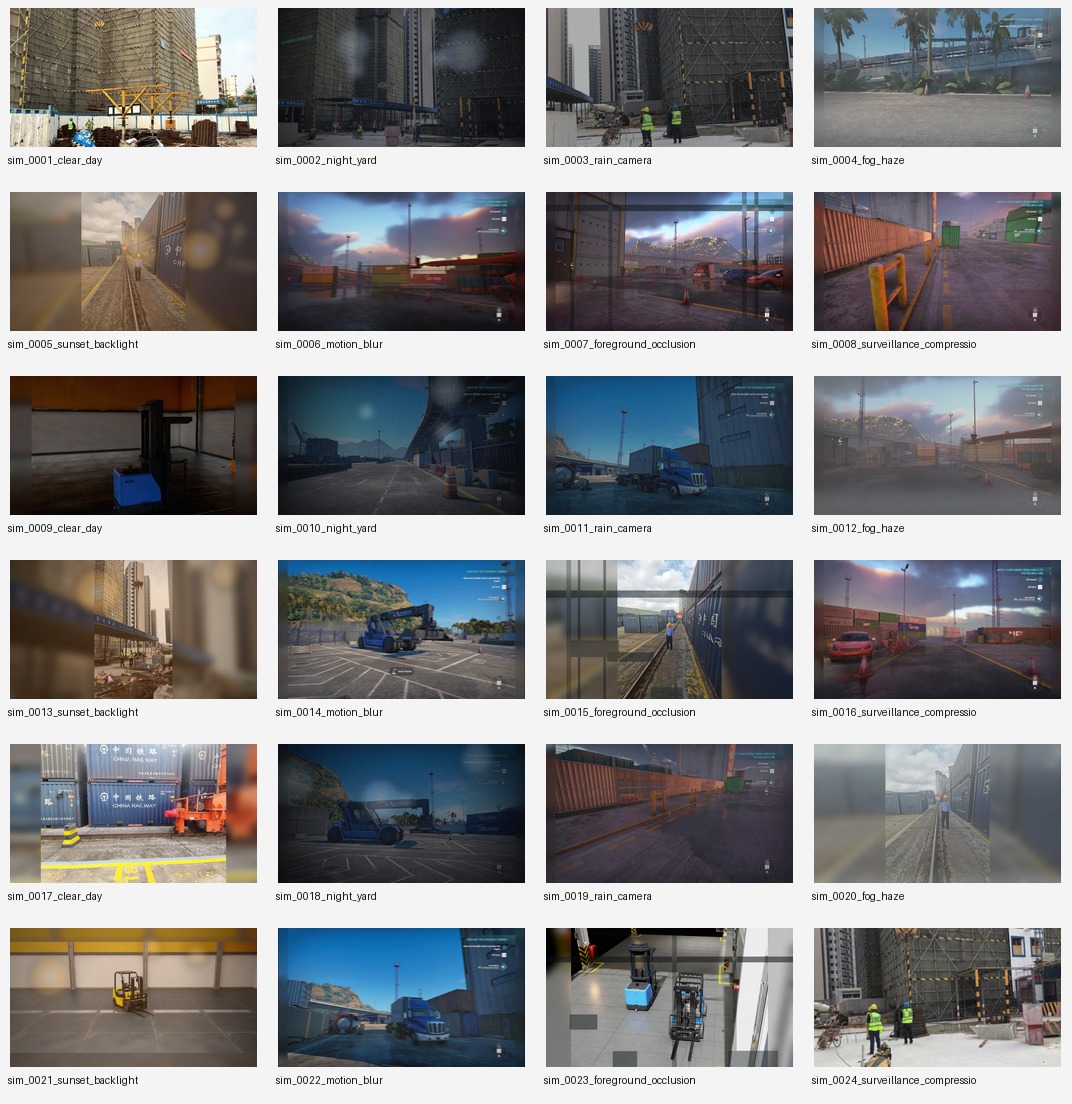
The gantry-scene simulation types were clear_day, night_yard, rain_camera, fog_haze, sunset_backlight, motion_blur, foreground_occlusion and surveillance_compression. Each type produced six images, for a total of 48 JPG images at 1280 by 720. The metadata.csv file records source members, simulation scenes, random seeds and transformation parameters. The quality summary shows that all 48 metadata rows matched 48 image files, with no recorded errors, unknown rows, external-source rows, low-information candidates or near-duplicate pairs.
Generated Data Assets
The project produced several deliverable groups. The gantry simulation demo includes 48 augmented images, a simulation contact sheet, an original-sample contact sheet, a class list, metadata and quality-check summaries. The quality summary reports class-hint counts of forklift 16, cone 15, person 13 and bollard 4. Brightness statistics were 39.4, 94.55 and 137.5, while standard-deviation statistics were 15.5, 37.3 and 62.6. These values describe sample distribution and are not model-performance metrics.
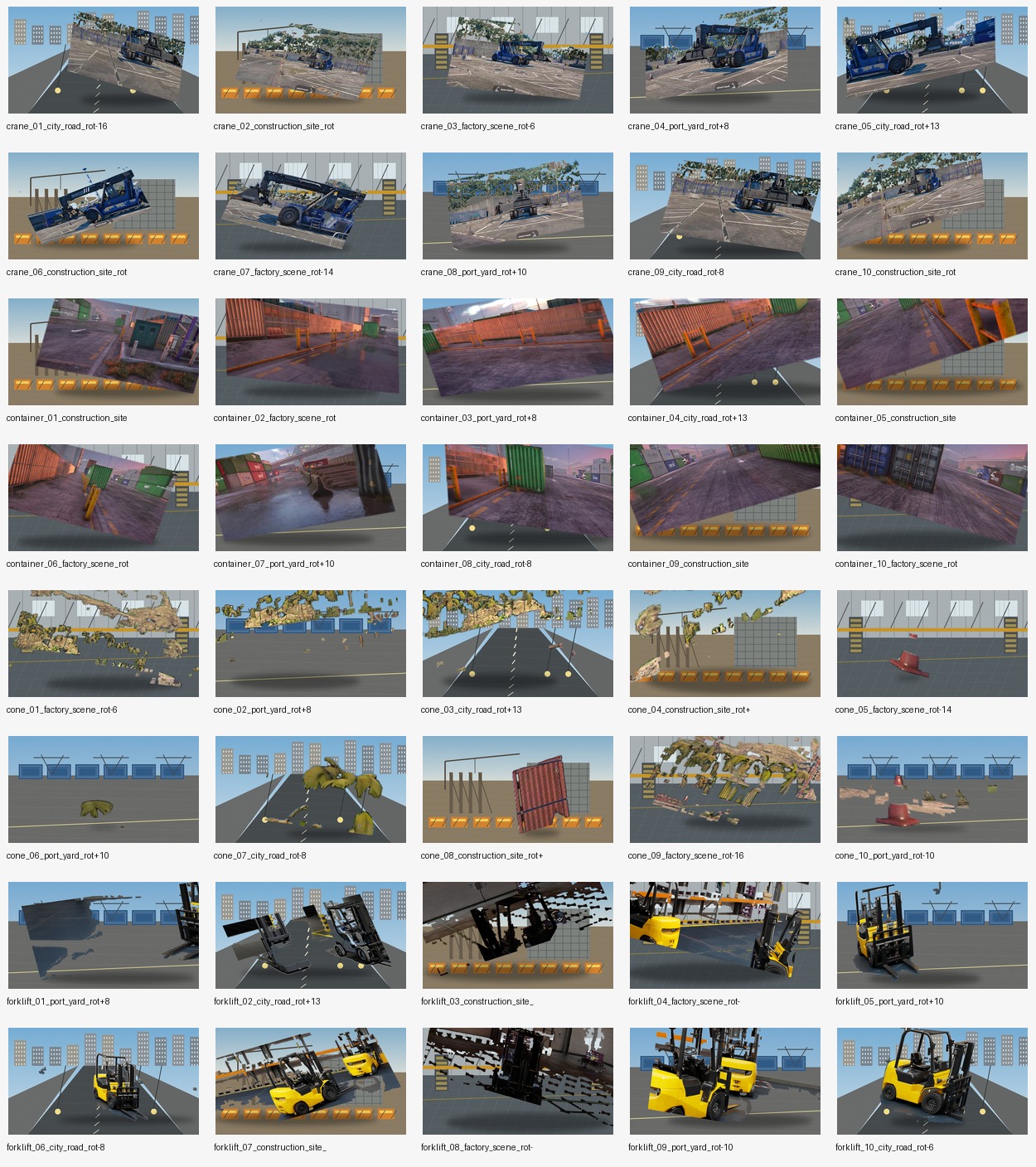
The four-class synthetic dataset contains crane, container, cone and forklift samples, ten per class and forty in total. It records background, rotation angle, shear, scale, horizontal flip, target center and bottom position. A separate AI-generated visual sample set also covers forklift, crane, container and cone, again ten per class and forty in total, so the customer can quickly review target appearance in engineering scenes. Three foreground-pose and background-compositing samples were also generated to show pose and scene-variation directions.
Eight Engineering Scenario Materials
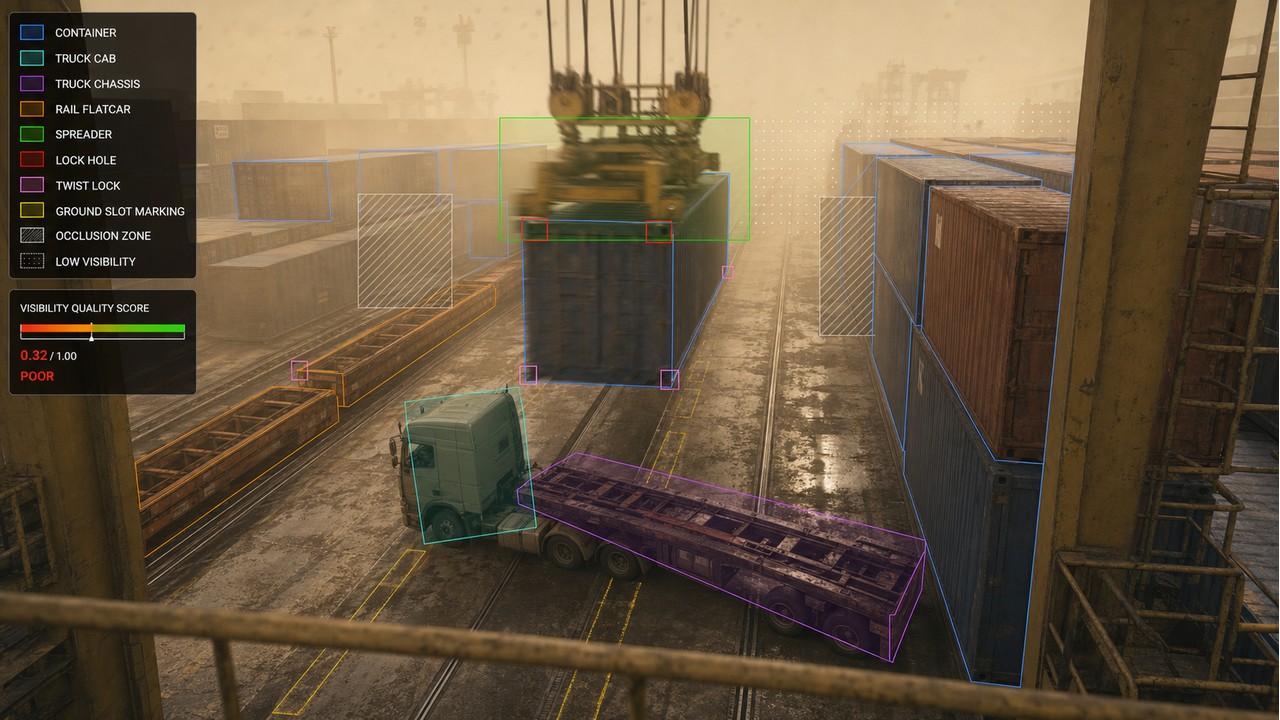
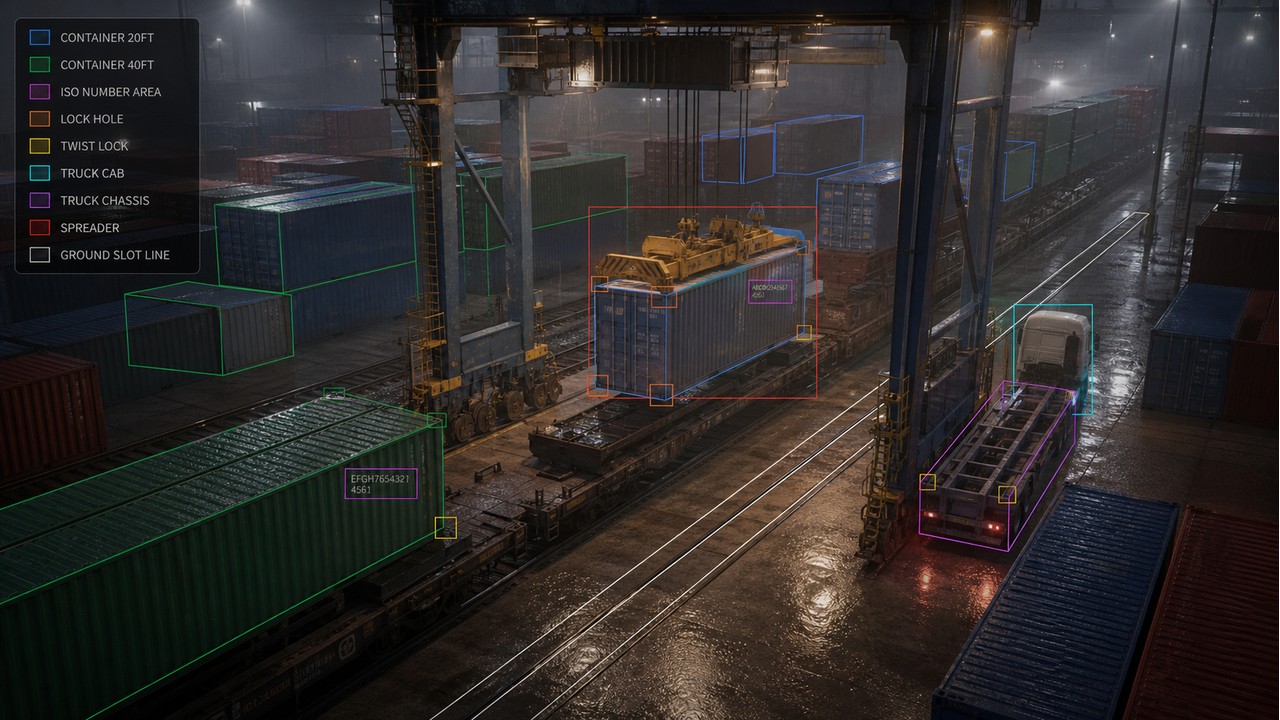
The project also prepared eight visual case materials with images, lightweight OBJ scene files, JSON metadata, CSV index and an overview image. The scenarios include tunnel construction vehicle meeting and obstacle recognition, port gantry operation in rainy night fog, tunnel entrance high-dynamic-range driving-area recognition, daytime container OCR and vehicle recognition, bridge underside crack and spalling inspection, bridge bearing and expansion-joint defect inspection, low-visibility tunnel mist and mud, and port dust occlusion with multiple containers.
These assets translate abstract synthetic-data requirements into business objects, difficult conditions and annotation discussions. For example, the rainy-night port case includes gantry crane, spreader, container, truck, lock hole, twist lock and slot line targets. The bridge underside case includes cracks, spalling, exposed rebar, rust, water stains and complex-texture negatives. The images shown publicly are simulated demonstration samples and do not use customer field originals.
Implementation Workflow
The workflow covered material inventory, scenario modeling, sample generation, metadata organization, quality checks and customer-facing documentation. Material inventory confirmed available classes, annotation status and whether the data could be used directly for model training. Scenario modeling converted port gantry crane, tunnel construction and bridge inspection needs into target classes, environmental variables, camera perspectives and annotation types. Sample generation created night, rain, fog, backlight, motion blur, foreground occlusion, low visibility, compression artifacts and surface wear conditions.
Metadata organization recorded source, scenario, random seed, augmentation parameters, class hints and output paths for traceability. Quality checks focused on sample counts, file existence, source consistency, low-information images, near duplicates, brightness and texture differences. Customer-facing documents then packaged image and 3D examples, data-collection requirements, demonstration cases and collection guidance so the customer could clarify video, sample-image, close-up, difficult-condition, metadata, calibration and 3D-material needs before project expansion.
Applicable Value
This type of vision data simulation is useful when field collection is expensive, long-tail scenarios are rare, privacy or safety restrictions exist, or an early project lacks complete annotations. It can align requirements before field collection, expose class and annotation gaps, and support a proof-of-concept stage with demonstration assets, collection checklists and a data-loop starting point.
For gantry crane and port-yard projects, simulation helps evaluate rain, night, fog, sand occlusion, surface dirt, vehicle misalignment, spreader motion blur, small lock-hole targets and slot-line occlusion. For tunnel and bridge projects, it helps organize low light, mist, mud, strong backlight, complex structural texture, fine cracks and drone-view changes.
Delivery Boundary
This case does not treat simulated samples as completed model training, nor does it present image-level augmentation as a fully annotated detection or segmentation dataset. If the project proceeds to YOLO, Detectron, segmentation models, OCR models or 3D reconstruction, it will still need bounding boxes, masks, OCR character labels, camera parameters, 3D calibration, real negative samples and an independent field acceptance set. Synthetic data should be validated together with real data through a reproducible training, evaluation and regression process.
FAQ
Can synthetic data replace real field collection?
No. Synthetic data supports long-tail supplementation, collection-standard discussion and early validation. Production models still require real field data, annotation quality control and independent test-set evaluation.
Does this project include bounding-box annotations?
The available gantry package contained images and a class list, but no discovered bounding boxes or segmentation masks. This delivery is image-level simulation and visual sample generation; detection training requires additional annotation.
Why include port, tunnel and bridge materials together?
The three scenario groups expose different data problems: small objects and harsh weather in ports, lighting and visibility shifts in tunnels, and fine cracks plus complex textures in bridge inspection. Showing them together helps define later collection and annotation scope.